
 Posts
Posts


This was presented by Michael Wesch at the Library of Congress, June 23rd 2008. It is 55 minutes long and WELL worth a look.
Sunday, August 10, 2008
The Anthroplogy of YouTube


Wednesday, June 18, 2008
Society hard-wired for a fall?
Peter Wilson, Europe correspondent
The Australian
June 14, 2008
Here is a sample of an article on Susan Greenfield, ‘a passionate advocate for taking science to the masses’. It can be read as a companion article to my previous post:
People who spend many hours a day in front of computer screens and televisions, she warns, are going through an unprecedented process in which the brain is churning out and consuming excessive amounts of a natural chemical called dopamine. Other brain scientists agree that heightened levels of dopamine could produce important changes in the fine wiring and functions of the brain, suppressing certain types of more sophisticated thinking.
The hard scientific evidence is limited but Greenfield believes the result of all that screen time and addictive dopamine will be the biggest physical changes to the human brain since the Neanderthals 100,000 years ago, producing changes in behaviour and thought patterns that amount to nothing less than a different type of person.
Older generations - she describes them as "the people of the book" - have developed powers of imagination, empathy, context and meaning which she fears will be much reduced in "the people of the screen".
http://www.theaustralian.news.com.au/story/0,25197,23858718-28737,00.html
previous
The Australian
June 14, 2008
Here is a sample of an article on Susan Greenfield, ‘a passionate advocate for taking science to the masses’. It can be read as a companion article to my previous post:
People who spend many hours a day in front of computer screens and televisions, she warns, are going through an unprecedented process in which the brain is churning out and consuming excessive amounts of a natural chemical called dopamine. Other brain scientists agree that heightened levels of dopamine could produce important changes in the fine wiring and functions of the brain, suppressing certain types of more sophisticated thinking.
The hard scientific evidence is limited but Greenfield believes the result of all that screen time and addictive dopamine will be the biggest physical changes to the human brain since the Neanderthals 100,000 years ago, producing changes in behaviour and thought patterns that amount to nothing less than a different type of person.
Older generations - she describes them as "the people of the book" - have developed powers of imagination, empathy, context and meaning which she fears will be much reduced in "the people of the screen".
http://www.theaustralian.news.com.au/story/0,25197,23858718-28737,00.html
previous
Is Google making us stupid?
Nicholas Carr
Atlantic Monthly
July/August 2008
Here is a sample of this extremely important article subtitled 'What the Internet is doing to our brains':
Thanks to the ubiquity of text on the Internet, not to mention the popularity of text-messaging on cell phones, we may well be reading more today than we did in the 1970s or 1980s, when television was our medium of choice. But it’s a different kind of reading, and behind it lies a different kind of thinking—perhaps even a new sense of the self. “We are not only what we read,” says Maryanne Wolf, a developmental psychologist at Tufts University and the author of Proust and the Squid: The Story and Science of the Reading Brain. “We are how we read.” Wolf worries that the style of reading promoted by the Net, a style that puts “efficiency” and “immediacy” above all else, may be weakening our capacity for the kind of deep reading that emerged when an earlier technology, the printing press, made long and complex works of prose commonplace. When we read online, she says, we tend to become “mere decoders of information.” Our ability to interpret text, to make the rich mental connections that form when we read deeply and without distraction, remains largely disengaged.
Reading, explains Wolf, is not an instinctive skill for human beings. It’s not etched into our genes the way speech is. We have to teach our minds how to translate the symbolic characters we see into the language we understand. And the media or other technologies we use in learning and practicing the craft of reading play an important part in shaping the neural circuits inside our brains. Experiments demonstrate that readers of ideograms, such as the Chinese, develop a mental circuitry for reading that is very different from the circuitry found in those of us whose written language employs an alphabet. The variations extend across many regions of the brain, including those that govern such essential cognitive functions as memory and the interpretation of visual and auditory stimuli. We can expect as well that the circuits woven by our use of the Net will be different from those woven by our reading of books and other printed works.
http://www.theatlantic.com/doc/200807/google
Atlantic Monthly
July/August 2008
Here is a sample of this extremely important article subtitled 'What the Internet is doing to our brains':
Thanks to the ubiquity of text on the Internet, not to mention the popularity of text-messaging on cell phones, we may well be reading more today than we did in the 1970s or 1980s, when television was our medium of choice. But it’s a different kind of reading, and behind it lies a different kind of thinking—perhaps even a new sense of the self. “We are not only what we read,” says Maryanne Wolf, a developmental psychologist at Tufts University and the author of Proust and the Squid: The Story and Science of the Reading Brain. “We are how we read.” Wolf worries that the style of reading promoted by the Net, a style that puts “efficiency” and “immediacy” above all else, may be weakening our capacity for the kind of deep reading that emerged when an earlier technology, the printing press, made long and complex works of prose commonplace. When we read online, she says, we tend to become “mere decoders of information.” Our ability to interpret text, to make the rich mental connections that form when we read deeply and without distraction, remains largely disengaged.
Reading, explains Wolf, is not an instinctive skill for human beings. It’s not etched into our genes the way speech is. We have to teach our minds how to translate the symbolic characters we see into the language we understand. And the media or other technologies we use in learning and practicing the craft of reading play an important part in shaping the neural circuits inside our brains. Experiments demonstrate that readers of ideograms, such as the Chinese, develop a mental circuitry for reading that is very different from the circuitry found in those of us whose written language employs an alphabet. The variations extend across many regions of the brain, including those that govern such essential cognitive functions as memory and the interpretation of visual and auditory stimuli. We can expect as well that the circuits woven by our use of the Net will be different from those woven by our reading of books and other printed works.
http://www.theatlantic.com/doc/200807/google
Thursday, June 12, 2008
HOPE

Hope is a film that documents the fate of the people-smuggling vessel SIEV-X and the 353 people who died when it sank en route to Australia. Here is the link to the official website: http://www.hopedocumentary.com.au/hope/index.htm
For the past three years Steve Biddulph has been working to build a suitable memorial in Canberra for victims and survivors of the SIEV X sinking. The photo above that shows a few of the 353 memorial poles is taken from Wikipedia:
http://en.wikipedia.org/wiki/SIEV-X#SIEV_X_Memorial
Friday, May 30, 2008
The Medieval Imagination
There has been a a marvellous series of free lectures at the State Library of Victoria around the event, 'The Medieval Imagination', an exhibition of medieval manuscripts. The above video reminds us of the disruptive nature of the new technology of 'the book' and this link gives a taste of the exhibition, including a gallery and audio tour,
http://www.slv.vic.gov.au/programs/exhibitions/kmg/2008/medieval_imagination
Wednesday, May 07, 2008
Aramaic
This is the Lord's Prayer in Aramaic, the language that Jesus spoke. It illustrates so well the distinctive sound and flavour of Eastern Christianity, much of which has been forgotten and lost in the West. When I listen to this being chanted, it reminds me of the whirling dervishes, both their music and movement. I read once that prostrations were a common practice in early Christianity, something associated with Islam today.
Wednesday, April 30, 2008
The tree is blooming
 These purple flowers symbolise the growth so far
 and the promise of growth to come.
Wednesday, April 23, 2008
Tuesday, April 22, 2008

Monday, April 21, 2008
Season of mellow fruitfulness
.JPG) Right now, the deck still looks much like this but soon...
Right now, the deck still looks much like this but soon... It will look like this, a photo taken on our deck last autumn...
Monday, January 28, 2008
Sunday, January 27, 2008
Wednesday, January 09, 2008
New Year's Breakfast 2008
THE INVITATION
NEW YEAR’S BREAKFAST 2008
Journeys: Past and Future
Journeys change us - emotionally, intellectually, politically, aesthetically and spiritually - so that we are never the same as before.
From our experience of journeys, what message do we have for our fellow Australian citizens for 2008?
As a starting point, we suggest you bring A PIECE OF WRITING OR IMAGE related to travel – to any destination, for any reason. This might be a postcard (sent or received), a photo, a letter, a journal extract or aerogram.
WHEN: 11am, Tuesday, 1st January 2008
THE BREAKFAST TABLE -
before and after


Saturday, January 05, 2008
Different seasons in my garden
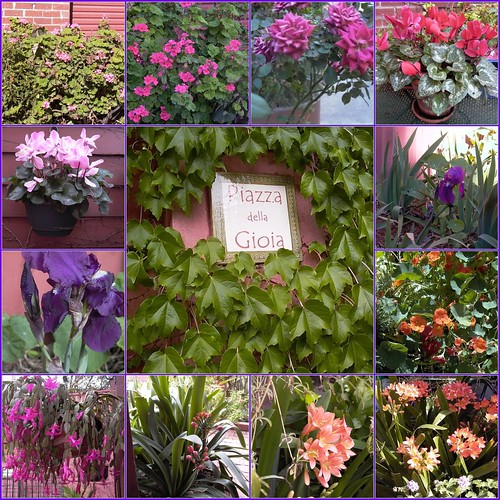
In our water-deprived garden, this lush mosiac made in the middle of last year feels especially precious...
Sunday, November 25, 2007

.jpg)

Wednesday, November 14, 2007
Zorba the Greek Yolngu style
Frank Djirrimbilpilwuy from Milingimbi has been in the Indigenous Media Industry for many years and has been a long-standing member and supporter of the Top End Aboriginal Bush Broadcasting Association, TEABBA Radio. As the man behind the camera and release of the video, Frank is also representing the dance group who call themselves "The Chooky Dancers". Frank has said that he filmed the footage at this years Ramingining Festival on the 30th September 2007 and knew it would be "something special" as soon as he saw the boys rehearsing.
The Chooky Dancers are a group of 10 energetic young men who had healthy living in mind when they choreographed the performance. Frank's son Lionel is the lead dancer in the video footage at front and center. "They (the Chooky Dancers) begun working on this just after this years Garma Festival in Gukula and worked very hard on it, they also do a Bollywood style performance which is also fantastic" Frank said.
Thursday, November 08, 2007
A vision of students today
This is a short YouTube video summarizing some of the most important characteristics of students today - how they learn, what they need to learn, their goals, hopes, dreams, what their lives will be like, and what kinds of changes they will experience in their lifetime.
Created by Michael Wesch in collaboration with 200 students at Kansas State University.
Wednesday, November 07, 2007
Crossing Thresholds from 20th to 21st Century
I made this slide show quite a while ago but still love what it says.
The music is courtesy of www.freeplaymusic.com
Sunday, November 04, 2007
In honour of the Garden Gals
I made this digital story after our latest gathering yesterday.
We have been meeting every six weeks for over ten tears.
The music, 'Arriving Abroad', is courtesy of www.freeplaymusic.com
Subscribe to:
Posts (Atom)